
The Capacity Math Behind Injectable Drug Delivery Device Programs
Written by
Arterex Medical
Published on
August 14, 2025
Read time
6 minute read
For most of the last decade, the hard part of bringing an injectable drug delivery device to market was the device itself. Getting the mechanism right, getting the human factors right, and getting through verification and validation absorbed most of the program risk. That calculation has shifted over the past two years. Demand for injectable presentations has grown faster than the manufacturing base that supplies them, and the lead time on adding qualified capacity is measured in years rather than quarters.
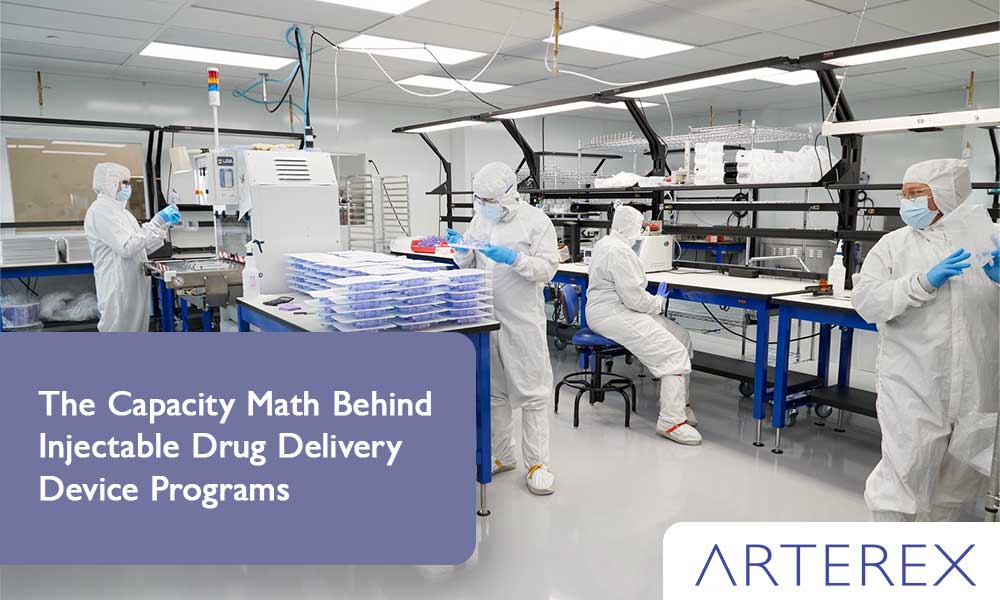
Programs that treat manufacturing capacity as something to secure after design freeze are increasingly finding that the decision needed to be made much earlier.
The Demand Behind the Squeeze

The scale of the underlying demand is well documented. J.P. Morgan Research projects the global incretin market to reach roughly 200 billion dollars by 2030, with approximately 25 million Americans on GLP-1 therapies by that point compared with around 10 million in 2025. The effect reaches well past a single drug class, because the broader injectable pipeline has grown alongside it. On its second quarter 2026 earnings call in August, Stevanato Group described a global pipeline of more than 9,000 injectable assets, over 60 percent of which are biologics.
The component and device suppliers are reporting the same picture from their own order books. West Pharmaceutical Services reported in July 2026 that its high value product delivery devices grew 29 percent year over year. Speaking to MDDI in April 2026, West’s Shane Campbell described injectables growing at roughly a 9 percent compound annual rate through 2035, against about 5 percent for oral presentations, with industry consensus holding that oral GLP-1 formulations will settle at around 30 percent of that market rather than displacing injectables.
What the 2026 Build-Out Actually Looks Like
The industry response has been substantial, and it is visible in public announcements rather than analyst speculation. Over an eighteen-month period, several of the largest names in injectable device manufacturing have committed capital at a scale that tells you how they read the demand curve.
- MGS opened a 300,000 square foot facility in Richfield, Wisconsin in February 2026, including a 140,000 square foot ISO Class 8 cleanroom dedicated to autoinjector and prefilled pen production, with a second phase intended to double that capacity.
- West Pharmaceutical announced a 165,000 square foot expansion of its Damastown facility in Dublin in March 2026, described explicitly as supporting high-volume injectable therapies including next-generation GLP-1 treatments.
- Ypsomed reported delivery systems revenue of 601.5 million Swiss francs for its 2025 to 2026 financial year, growth of 20 percent, against capital expenditure of 295.6 million Swiss francs and a record 44 newly won customer projects, with expansion underway across Schwerin, Solothurn, Changzhou, and Holly Springs, North Carolina.
- Stevanato Group confirmed in August 2026 that its first device program will reach commercial production later this year, with full ramp expected by the end of 2028.
These announcements describe an industry adding capacity as quickly as it reasonably can. They also describe capacity that will not be fully available for years, which is the part of the story that matters most to a program planning a launch.
Why Qualified Capacity Takes Years to Add
The gap between announcing capacity and running validated commercial product is where injectable programs get caught. Reporting in June 2026 put the construction of a commercial facility at roughly two years, followed by another three to six months for process validation, with a new fully qualified commercial line typically requiring 18 to 24 months to commission. MGS described its own Richfield facility as taking 22 months from concept to operation, which is consistent with those figures and represents a well-executed project rather than a delayed one.
Nothing in that sequence compresses easily. Automated assembly equipment must be specified, built, factory accepted, installed, and qualified. Installation qualification, operational qualification, and performance qualification each generate protocols, execution, data analysis, and reports that become part of the regulatory record. Tooling must be validated alongside the process it feeds. Where a device is part of a combination product, the qualification work carries obligations that a purely mechanical device would not attract. The Outsourced Pharma 2026 CDMO forecast, published in January, recommended engaging manufacturing partners six to eight months ahead of an intended start date, and that guidance applies to programs entering an existing qualified line rather than programs requiring new capacity to be built.
How Tight the Market Actually Is
The honest answer is that the picture is uneven, and anyone describing the market as uniformly sold out is overstating it. On the same August 2026 earnings call, Stevanato described deliberately maintaining a degree of free capacity to preserve flexibility for sampling and validation work on future programs, which is not the posture of a supplier turning business away. At the same time, the constraint appears real at the margins. Writing in Outsourced Pharma in December 2025, one industry professional described smaller customers suddenly being unable to secure slots they had counted on for years, and attributed part of the pressure to GLP-1 expansion drawing skilled labor across the CDMO landscape.
Speaking to ONdrugDelivery in May 2026, Andy Wertheim of Quvara Medical went further, putting potential GLP-1 device demand above one billion units annually and describing program timelines slipping because suitable manufacturing partners lacked available capacity rather than because of device design or regulatory obstacles. That assessment comes from a supplier operating in the market it describes, so it is worth weighing accordingly, though the mechanism it points to is consistent with the labor and slot pressure reported elsewhere.
There is one unambiguous, on-the-record precedent for device capacity constraining product strategy. In November 2024, Novo Nordisk cited its capacity constraints when it announced a global transition of human insulin from pen presentations to vials only. When capacity binds, it binds at the level of what a patient receives.
The Regulatory Overlay Most Capacity Conversations Miss

Capacity planning for injectable devices carries a regulatory layer that a conversation about square footage and press tonnage tends to skip. Where the device is supplied as part of a combination product, 21 CFR Part 4 Subpart A governs the current good manufacturing practice requirements, and the only FDA guidance addressing those requirements directly remains the final guidance issued in January 2017. The agency’s draft guidance on Essential Drug Delivery Outputs, issued in June 2024, has not been finalized, which leaves an area of genuine interpretive uncertainty for programs currently in development.
The device standards themselves have moved more recently. ISO 11608, the series covering needle-based injection systems for medical use, received two amendments in April 2026. ISO 11608-1:2022 was amended on April 24 and ISO 11608-3:2022 was amended on April 17. Both are short amendments rather than wholesale revisions, and they have attracted very little commentary so far, which means a program working from a design history assembled before that date should confirm which edition its documentation reflects.
What to Confirm With a Manufacturing Partner Before You Need the Capacity
The useful conversation with a contract manufacturer happens well before a purchase order, and it is more specific than asking whether capacity is available.
1. Ask what is qualified today rather than what is planned
Announced capacity and validated capacity are separate things, and the distance between them is measured in quarters. Ask which cleanrooms are certified, to which class, at which site, and which assembly lines are running validated commercial product now. A partner that can answer at that level of specificity is describing something you can plan against.
2. Ask where the headroom sits
A facility running at full utilization can be an excellent partner for a program already underway and a difficult one for a program that needs to scale. Ask how much cleanroom floor is available for expansion, whether the site has physical space and utilities provisioned for additional molding or assembly equipment, and how recently capacity was last added. Documented headroom is the difference between a partner who can grow with a program and a partner who becomes the constraint.
3. Ask how validation work is resourced
The bottleneck on a transfer or a scale-up is frequently validation engineering rather than machinery. Ask whether installation, operational, and performance qualification are executed in house, how validation protocols are written and approved, and what statistical basis is applied. A partner running that work internally controls its own schedule in a way that a partner outsourcing it does not.
4. Ask about tooling proximity
For molded device components, the location and availability of the tool room shapes how quickly an engineering change or a maintenance event resolves. A tool room operating on the same campus as the presses, on a continuous schedule, turns a design change into a matter of hours or days. Tooling handled by a third party at distance turns the same change into a matter of weeks.
The Bottom Line on Drug Delivery Device Capacity
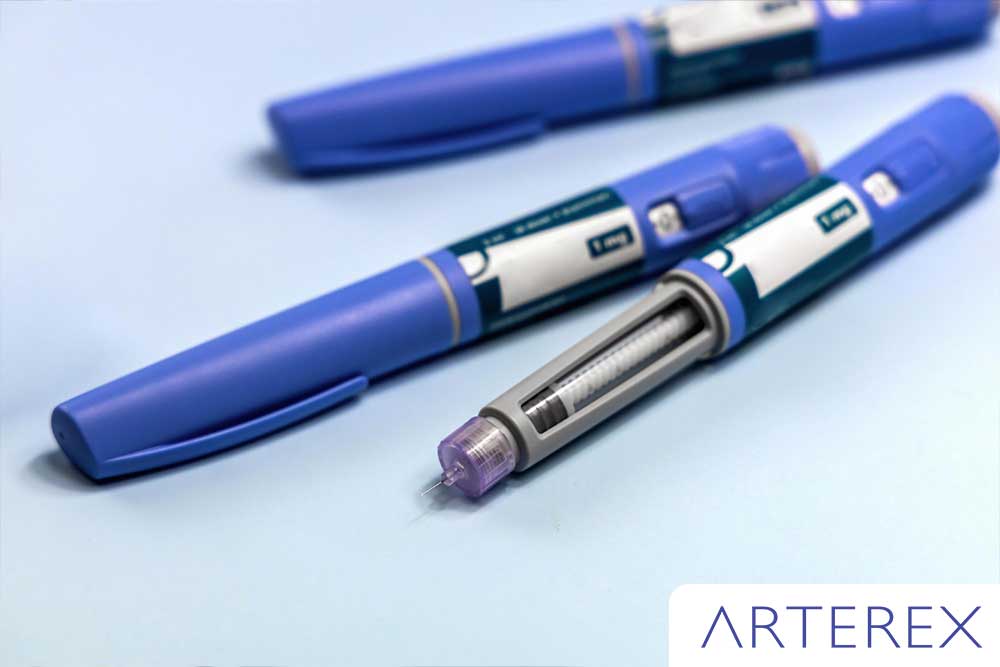
Injectable device demand has grown faster than the qualified manufacturing base, and the industry is responding with a capital build-out that is well documented and genuinely large. The constraint that remains is time, because construction, equipment lead times, and qualification follow a sequence that resists compression regardless of how much capital is committed to it.
For a program in development now, the practical implication is that manufacturing capacity belongs in the conversation at the same point as design inputs rather than after design freeze. The questions worth asking are about qualified capacity that exists today, headroom that can be brought online without starting from an empty building, and validation resources that a partner controls directly.
Arterex Medical opened a new 9,000 square foot ISO Class 8 cleanroom at its Tecate facility in July 2026, purpose-built for molding, extrusion, and device component assembly, on a campus already running 110 molding presses from 10 to 900 tons across 240,000 square feet with a tool room operating around the clock. Our drug delivery work spans high-volume automated assembly through to Class III programs, including an implantable drug delivery pump with programmable flow from 0.10 to 28 milliliters per day and a ten-year implant life. Installation, operational, and performance qualification are executed in house across our manufacturing network. If you are mapping the capacity your program will need and when it will need it, our team can walk through what is qualified and available today.
- The Capacity Math Behind Injectable Drug Delivery Device Programs
- The Demand Behind the Squeeze
- What the 2026 Build-Out Actually Looks Like
- Why Qualified Capacity Takes Years to Add
- How Tight the Market Actually Is
- The Regulatory Overlay Most Capacity Conversations Miss
- What to Confirm With a Manufacturing Partner Before You Need the Capacity
- The Bottom Line on Drug Delivery Device Capacity